Burning Cone Morphology: Technical Observation Methods and Their Reflection of Fill Density and Moisture Issues
Through systematic morphological observation methods, transform microscopic changes in the burning cone into quantifiable process diagnostic indicators
Preface: 2:15 AM, The Flame
At 2:15 AM in the monitoring room of Production Line 1, the air carried a distinctive scent — a mix of coolant and fine dried tobacco dust. Apart from the low-frequency hum of precision instruments, the sole visual focus was the flickering flame cone under the high-magnification observation lens.
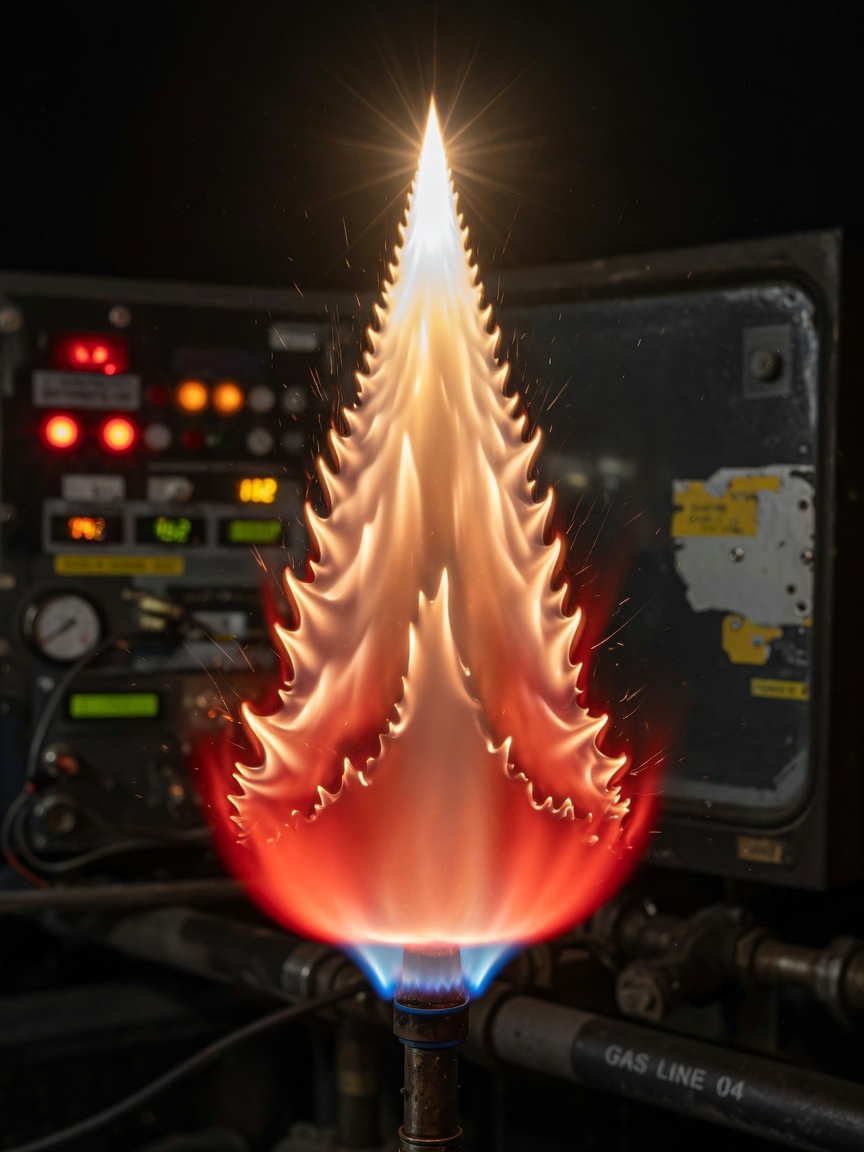
I stared at the screen, my pupils slightly contracting. Within that extremely tiny combustion zone, less than 15 mm in diameter, the flame was displaying a highly unusual "serrated" edge. This was no ordinary combustion fluctuation; it was a signal of some deep-seated physical parameter imbalance. Over ten years of observation, I had countless times predicted impending batch quality accidents a full ten minutes before any alarm sounded, simply through such subtle morphological deviations.
For a technical observer, the burning cone is not merely a flame geometry — it is a real-time feedback "sensor." Every tremor of its form silently narrates the struggle between the product's internal fill density and moisture content.
I. Fundamentals of Burning Cone Morphology: The Geometric Definition of an Ideal State
To diagnose anomalies, we must first build an absolute understanding of the "ideal state." In a standardized laboratory environment, a perfect burning cone should possess the following physical characteristics:
- Geometric Stability: The ideal burning cone should present a stable conical shape, with its half-angle maintained within a specific value range (e.g., 25°–30°, depending on product specifications). The apex of the cone should be sharp, with no obvious blunting or collapse.
- Brightness and Color Gradient: The color should transition smoothly from a bright white-yellow at the top to a dark red at the lower part of the cone, and this gradient should exhibit high continuity over time, without sudden flickering or color-block jumps.
- Heat Flow Stability: Under thermal imaging observation, the heat flow field around the cone should appear symmetrically diffuse, with no obvious eccentricity.
When these parameters are within the baseline, we default to the product's fill density having reached the target value, and the moisture content being at the process-required equilibrium (typically a dynamic range around 12%–14%).
II. Diagnostics of Abnormal Morphology: From Form to Essence
When observed morphological deviations occur, we need to infer the underlying physical causes through morphological characteristics.
1. Collapsed Morphology
Characteristic Description: The cone height is noticeably reduced, the tip becomes rounded and blunt, and there may even be an inward contraction trend. The overall appearance resembles a flattened bulb.
Physical Diagnosis: This is typically a combined feedback of excessively high fill density or abnormally high local moisture.
- High-Density Effect: When fill density exceeds the set threshold, the gaps between fibers are extremely compressed, hindering oxygen diffusion to the combustion core. The combustion reaction, deprived of sufficient oxygen, cannot maintain its original expansion force and is forced to contract toward the center.
- High-Moisture Coupling: Excessive moisture not only increases heat capacity and lowers combustion temperature — more importantly, the latent heat of moisture evaporation absorbs a large amount of combustion energy, causing the flame to be unable to support the original cone structure, thereby triggering "collapse."
2. Expanded Morphology
Characteristic Description: The cone half-angle abnormally increases, the edges become blurred, and a "flare-like"diffusion shape may even appear.
Physical Diagnosis: This typically points to insufficient fill density or moisture content being too low.
- Low-Density Effect: Sparse filling causes the airflow field to lose physical constraint, allowing excessive oxygen to enter the combustion zone, leading to uncontrolled combustion reactions that spread outward along the path of least resistance.
- Low-Moisture Effect: Lack of moisture causes excessive heat dissipation. The combustion zone loses the "heat buffer" provided by moisture evaporation, causing combustion intensity to rise abnormally and the flame to expand accordingly.
3. Oscillating/Serrated Morphology
Characteristic Description: The cone edge is no longer smooth but exhibits high-frequency, sawtooth-like pulsations, or macroscopically manifests as periodic bright-dark flickering.
Physical Diagnosis: This is a typical manifestation of combustion stability being perturbed, often reflecting microscopic thermal field disorder caused by uneven filling.
- This morphology typically appears in batches where fill density is at a critical point, or moisture distribution is extremely uneven. Alternating local high-humidity and low-humidity zones cause combustion thermodynamic parameters to fluctuate violently within very short periods. The flame oscillates repeatedly between "expansion" and "contraction," ultimately forming the serrated illusion visually.
III. Core Logic: A Synergistic Model of Fill Density and Moisture
As observers, we cannot view density or moisture in isolation. Together, through thermodynamic and fluid dynamic coupling, they determine the burning cone's morphology.
We can establish a simplified logical chain:
[Fill Density ↑] → [Oxygen Diffusion Rate ↓] → [Combustion Intensity ↓] → [Cone Contraction]
[Moisture ↑] → [Effective Calorific Value ↓] → [Flame Temperature ↓] → [Cone Collapse]
When both increase simultaneously, a "negative feedback superposition effect" occurs, causing extremely severe collapse morphology that may even extinguish combustion. Conversely, when both decrease simultaneously, a "positive feedback expansion effect" occurs, leading to uncontrolled flame.
This coupling relationship is dynamically variable on the production line. For example, at a moisture level of 13.5%, a change in fill density from 0.35 g/cm³ to 0.38 g/cm³ may cause the cone half-angle to sharply drop from 28° to 22°. This extremely high sensitivity is precisely the core value of our morphological observation.
IV. Practical Case: The Late-Night Investigation of a "0.4% Moisture Fluctuation"
I still clearly remember the experience of November 14, 2024. At that time, Production Line 1 was conducting a large-scale continuous production batch.
Observation Record:
At 3:10 AM, through the high-magnification observation lens, I discovered that the burning cone morphology of Unit 7 showedobvious "edge serration." Although output and basic thermodynamic data were still withinacceptable range at that time, this morphological fluctuation was highly unusual.
Investigation Process:
I immediately retrieved the environmental data surrounding that batch. First, I checked fill density — the result showed density stable at 0.36 g/cm³, ruling out density fluctuation. Next, I retrieved humidity sensor data and found that although the real-time display value was 13.2%, the fluctuation curve revealed that over the past 20 minutes, humidity had undergone a tiny, virtually imperceptible upward trend, climbing from 12.8% to 13.2%.
Although this was merely an absolute change of 0.4%, in a high-precision combustion model, this is sufficient to alter the microscopic adsorption state of fiber surfaces.
Root Cause Analysis:
After a thorough inspection of the air compressor system, we discovered that a tiny leak in the exhaust pipeline had caused an extremely subtle change in the local humidity of the ambient air during transport. This change entered the production line through the delivery system, altering the moisture distribution on the tobacco shred surfaces, which in turn changed the combustion thermodynamic parameters, visually manifesting as the serrated fluctuation of the burning cone.
Resolution:
We promptly corrected the air compressor pressure and strengthened monitoring of humidity gradient changes in subsequent batches. This incident once again proved: morphological abnormalities often precede changes in physical parameters.
V. Conclusion: Finding Order in Minute Changes
Technical observation is not merely about looking — it is a deep interpretation of physical laws. The burning cone's morphology is the "projection" of complex production processes at a macro scale.
An excellent observer should be able to penetrate the flame's brightness and darkness, to see the density of fibers behind it, to perceive the gain and loss of moisture. Within these seemingly chaotic flame pulsations, a profoundly rigorous physical order is hidden. Mastering this order allows us to maintain calm and precise control amidst the noise of industrial production.
Fill Density ↑
Oxygen diffusion hindered → Combustion intensity ↓ → Cone contraction
Moisture ↑
Effective calorific value ↓ → Flame temperature ↓ → Cone collapse